The Diploma Is a Rating Agency Grading Its Own Bonds
By Allen Chan
July 21, 2026

A student submits a flawless essay. Well-structured, properly cited, grammatically clean. A teacher asks her to explain her thesis. She cannot do it for ninety seconds.
The artifact is real. The capability is not. And the system that issued her grade has no mechanism to tell the difference.
This is no longer an edge case. It is the central crisis in education, and it arrived the moment large language models made it possible to produce expert-level output without expert-level understanding. The artifact and the capability have been decoupled, and every institution built to certify one by examining the other is now certifying something it cannot verify.
We spent thirty years removing every obstacle between a child and the answer. Test scores dropped anyway. That's not a coincidence, it's the mechanism working exactly as designed. AI didn't create this failure. It just made it impossible to ignore.
THE INVERSION
Text version
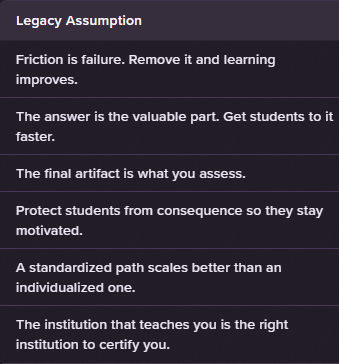
Legacy Assumption
- Friction is failure. Remove it and learning improves.
- The answer is the valuable part. Get students to it faster.
- The final artifact is what you assess.
- Protect students from consequence so they stay motivated.
- A standardized path scales better than an individualized one.
- The institution that teaches you is the right institution to certify you.
Text version
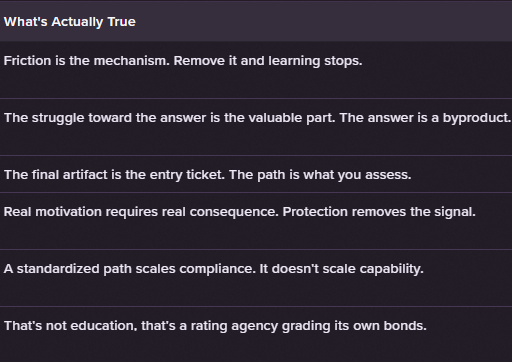
What's Actually True
- Friction is the mechanism. Remove it and learning stops.
- The struggle toward the answer is the valuable part. The answer is a byproduct.
- The final artifact is the entry ticket. The path is what you assess.
- Real motivation requires real consequence. Protection removes the signal.
- A standardized path scales compliance. It doesn't scale capability.
- That's not education, that's a rating agency grading its own bonds.
This isn't nostalgia for harder homework. It's a structural claim: a learning system with the friction engineered out cannot produce the thing it was built to produce, because the friction was never the obstacle. It was the mechanism. And an industry that certifies its own product has no incentive to notice.
WHY THE ANSWER TELLS YOU NOTHING
Here's the fact the entire credential economy is built to ignore: the answer contains no information about the person who produced it.
Two students submit identical, correct solutions. One derived it over three weeks, through two failed approaches, a false assumption caught on day nine, and a reconstruction from scratch in week three. The other generated it in forty seconds. The artifacts are identical. The people are not. One of them can solve the next problem, the one nobody has seen before. The other can only solve problems that already have answers.
Capability is not located in the output. It's located in the path: the false starts, the recovery patterns, the moments of being wrong and what happened next. That path is the only non-fungible evidence of learning. Two students can produce identical answers. They cannot produce identical journeys.
Every system built to assess the answer is assessing the one part of the process that carries the least signal.
THE CORE MECHANISM: THE JOURNEY CREDENTIAL
The fix is a single inversion, and it's operational, not philosophical:
You don't qualify for review until you produce the answer. But the answer is not what's reviewed. The path to the answer is.
Getting the answer right is the entry ticket, not the assessment. It proves the work converged somewhere coherent. What gets evaluated, graded, and credentialed is the documented journey: how the student approached the problem, where they broke, how they recovered, and whether they can defend every decision under questioning.
Call this the Journey Credential: a certification of the path, not the artifact. The diploma certifies that an answer was produced inside an institution with a financial interest in saying so. The Journey Credential certifies something the diploma structurally cannot, that a specific person passed through a specific struggle and came out the other side with capability that transfers.
This reframes everything. Cheating stops being an enforcement problem and becomes an evidentiary one: you can generate an answer, but you cannot generate a journey you didn't take, and you cannot defend one under live questioning for more than a few exchanges. The assessment doesn't need to detect AI use. It needs to be indifferent to it, because the thing being graded is the one thing AI cannot produce on your behalf.
HOW YOU DOCUMENT A JOURNEY
This is the part most reform proposals skip, because "value the process" is easy to say and hard to operationalize. Four concrete mechanisms:
- Version-tracked work as the default substrate. Students work in environments where the full edit trail exists by default: document revision history, code repositories, design tool versioning. The submission isn't the final file, it's the repo. The trail answers questions the artifact can't: Did they outline or dive in? Do they revise ruthlessly or patch? Did capability grow incrementally, or arrive in a single 2 a.m. leap? An assessor reading a revision history can distinguish generated understanding from scaffolded output in minutes, because real journeys have texture that fabricated ones don't.
- Decision journals at inflection points. Not keystroke logging, that's surveillance theater. At each moment the student changes direction, they write two sentences: what I believed, what I now believe, why. Twenty of these across a semester form a capability fingerprint. They're also nearly impossible to fabricate retroactively with quality, because invented journals read as smooth and rational, while real ones are lumpy, wrong-headed, and specific. (This is a testable claim, not a settled one.)
- The struggle portfolio. Each student curates their three hardest failures per term, with what changed after each. This becomes the credential that actually transfers: not "received an A," but "here is how this person behaves when they are wrong." It is the artifact employers, collaborators, and institutions genuinely want to see and currently have no way to request.
- The path defense. Oral examination, but pointed at the journey, not the conclusion. "Walk me through your draft history. Why did you abandon this approach on March 12? What did you try before this worked?" A student who lived the path answers fluently. A student who generated the artifact runs out of road within minutes, because there's a difference between knowing what the answer is and knowing what it cost. AI can sit in neither chair.
The path defense is also where the constraint floor gets enforced. A student whose journey shows no struggle at all, no wrong turns, no revision, no recovery, hasn't demonstrated mastery. They've demonstrated that the problem was too easy, or that the journey isn't theirs. Either way, the assessment caught it. That's what a working system looks like.
None of this requires new technology. It requires repurposing infrastructure that already exists, revision history, repositories, journaling, oral examination, around a different unit of assessment. The expensive part isn't the tooling. It's the assessor time, which is an honest cost addressed below.
THIS ALREADY WORKS. WE JUST FORGOT TO GENERALIZE IT.
None of this is speculative. Journey Credentials already exist, in the two domains where society decided the stakes were too high for artifacts alone.
Spoken language examinations have run exactly this model for decades: no artifact, no answer key, just a live, one-on-one dialogue where the assessor watches capability happen in real time. Final exams in university language programs are often entirely oral: drills, questions, open dialogue, pass or fail determined by what happens in the room. A student cannot fake fluency for fifteen minutes under adaptive questioning. The exam is indifferent to what tools the student used to prepare, because the thing being assessed exists only in the live performance of the path. A stumble doesn't fail the student, the professor probes, the student recovers, and the recovery itself is the data. Two students can produce the same correct sentence; one retrieved it from memory, one generated it from understanding, and a skilled examiner hears the difference.
Medical licensure makes the same demand at the highest possible stakes. The Objective Structured Clinical Examination, required for physicians in the US, UK, Canada, and elsewhere, puts candidates through live stations where they diagnose actors playing patients, observed and scored in real time. No written exam, however rigorous, is considered sufficient. We already refuse to let a written artifact credential the people who cut us open. The question is why we accept it for everyone else.
Language programs didn't adopt this out of philosophy. They adopted it because in language, the artifact and the capability were never coupled in the first place, a written exam simply cannot tell you whether someone can speak. Medicine adopted it because a multiple-choice score cannot tell you whether someone can save a life. In both cases, the path was always the only signal. AI has now put every other subject in the same position. The response isn't to invent a new assessment model. It's to notice that a proven one has been sitting in the modern languages department and the medical school the whole time, quietly credentialing millions of people, at a cost entire institutions already afford every term.
THE FAILURE LAYERS THE MECHANISM FIXES
The reason this inversion matters is that each failure in the current system is a failure to see the path.
The removed constraint. Autocomplete, answer keys, adaptive software that routes around the hard part the moment a student stalls. Each one deletes a place where the student had to sit in not-knowing and work their way out, and therefore deletes a segment of the path. A system assessing the journey notices when the journey is missing.
The simulated consequence. Retake the quiz. Regenerate the essay. Get the trophy anyway. A safety net with no floor underneath it isn't safety, it's the absence of stakes, and stakes are what make the choices in a journey mean anything. The participation trophy isn't the problem because it's kind. It's the problem because it severs the link between effort and outcome that generates the signal in the first place. The correct design isn't no safety net, it's a net that catches only fatal falls. Catch the student before catastrophic failure; let every recoverable failure land, because the recovery is the credential.
The unverified intermediary. The administrative layer that certifies process compliance without measuring capability. Compliance is not restoration. The honest question was never "was the accommodation documented," it's "can this student do the thing now that they couldn't do before." Journey-based assessment is the first design that can actually answer that question, because it measures the delta directly instead of inferring it from paperwork.
The self-graded credential. A university teaches a student, grades that student, and issues the credential certifying the grading was accurate, all inside one institution with a financial interest in the answer being yes. That's the same architecture the underwriting industry ran for decades: a rating issued by whoever is being rated, paid for by the party with the most to gain from a favorable result. A documented journey is portable evidence. It can be assessed by parties other than the one that profited from producing it. That's what breaks the self-grading loop.
WHEN REALITY BREAKS THE PLAN
This is not an argument for maximum friction everywhere. Struggle isn't automatically productive. A student without foundational skills doesn't need more unscaffolded difficulty, they need scaffolding removed in a sequence that matches where they actually are, not where the curriculum assumes they are. Trauma-driven shutdown looks like disengagement but isn't a constraint problem, it's a safety problem, and treating it as one invites harm.
There's also a resourcing trap worth naming directly: "authentic struggle" is an easy thing to prescribe for other people's kids. Under-resourced schools already run on more friction than any student should absorb alone, friction from scarcity, not from design. Romanticizing struggle without funding the support structure around it is just a more sophisticated way of abandoning students. The pillar is generative constraint, not constraint as a substitute for resources.
And it cuts both ways: the failure isn't equity as a goal, it's equity implemented as documentation instead of restoration. A school that removes a real barrier, a broken hearing aid, an unsafe commute, a genuine language gap, and then lets the student do the actual hard thing is closing a gap. A school that processes an accommodation and stops there has relocated the gap somewhere harder to see. Path documentation makes this visible too: a restored student's journey shows real struggle after the barrier is removed. A processed-and-abandoned student's journey shows silence.
THE HONEST ECONOMICS
Path-based assessment costs more assessor time per student than answer-key grading, directionally, not by a fixed number, because it depends on class size, subject, and how much of the review is tool-assisted. Reading a revision history is slower than scanning a final answer. Running a path defense requires a trained human in the room. The inconvenient line: this doesn't scale for free.
But it scales further than the objection assumes. Language departments run live oral exams for every student, every term, at ordinary public-university budgets. Medical schools run multi-station OSCEs for entire cohorts. If a fifteen-minute spoken final is affordable for Japanese 101, the claim that live assessment is categorically unaffordable is weaker than it sounds. The binding constraint isn't money alone, it's whether the system decides the signal is worth paying for.
The same is true one layer up. Independent verification of journeys by third parties, employers, guilds, professional bodies, costs more than a self-issued diploma, because self-issued verification is nearly free and independent verification isn't. That's not a flaw in the idea. It's the actual price of the thing the current system has been skipping. An industry that has never had to pay for verification will not adopt it because it's cheaper. It will adopt it because employers and students start demanding proof the credential alone no longer provides, and AI is accelerating that demand every semester.
THE REAL POSITION
The honest position isn't "bring back suffering." It's narrower: distinguish the friction that generates capability from the friction that's just scarcity wearing a disguise, and stop treating all discomfort as a bug to engineer away. Some of it is the product.
And it's one inversion deeper than that: stop credentialing the answer. The answer is the entry ticket. Credential the journey, because the journey is the only evidence of the thing education actually claims to produce, a person who can handle a problem nobody has seen before. The outcome is the receipt. The journey is the person.
Remove the intermediary that profits from the gap between "was taught" and "can do." Restore the real function underneath it, capability that transfers. Verify the journey independently, by someone with no stake in the answer being yes. Then let the truth be the cheap path, because a system that has to fake less will always cost less to run than one built to hide the gap.
That is what revolutionizing this industry actually looks like. Not more friction for its own sake, and not less. A system that can finally tell the difference between a student who did the thing and a student who produced the thing, and that credentials the first one.
This is testable, not just asserted. Live oral assessment already carries the full credentialing load in language education, and live performance assessment already gates medical licensure. Where journey-based assessment has been tried elsewhere, mastery-based progression with live demonstration, project-based learning with real deadlines, real audiences, and defended process, the claim is that retained capability and transfer to novel problems improve, even when initial scores look flat or worse. That's a derived claim worth checking against outcome data, not a truth to preach.
None of this is Raya.ai's product. Raya isn't an education company, and it isn't claiming to have solved pedagogy. What Raya is built on is the same architectural question underneath this whole series: how do you preserve something real, a student's authentic journey, a person's authentic decision-making, instead of letting it get quietly optimized away by whatever system is supposed to be serving it?
Raya's actual mechanism is a consented, sovereignty-preserving loop: an individual's profile lives at the edge, under their control, and only what they choose to contribute feeds a larger collective picture, de-identified, revocable, never extracted without consent. It's the same underlying move as this post: don't remove the thing that makes the signal real in the name of making it easier.
This is education as showcase, not as roadmap. The architecture underneath both is the same. What each domain does with it is not.
Raya.ai is live now.
If this piece resonated, if you're tired of systems that optimize away the thing that makes you real, Raya is built for exactly that. Your profile stays yours. Your clarity compounds. Your agent executes with your logic, not against it.
→ Raya AI — learn more → Download on iOS — start your journey
Questions, pilots, or collaboration → info@raya.ai