The Death of Agronomy
By Allen Chan
June 29, 2026
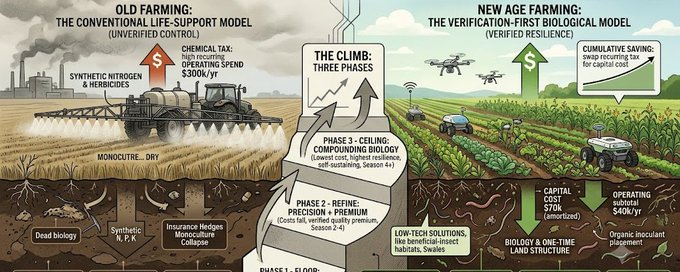
Modern farming doesn't have a yield problem. It has a life-support problem, and most of the cost goes toward hiding it.
Most of the money in conventional agriculture isn't spent growing food. It's spent propping up soil that's no longer alive.
Synthetic nitrogen substitutes for dead biological cycles. Broad-spectrum herbicides manage the symptoms of monoculture. Crop insurance hedges the collapse the whole approach makes more likely. Each input exists to mask the one beneath it, and the farmer pays the premium on all of them, in nutrient-thin food, runoff, and shrinking margins.
The shift worth paying attention to isn't a better tractor or a new seed. It's the chance to stop paying for that life-support system entirely, by rebuilding the soil biology the chemicals were faking and using automation to verify that biology rather than hide its absence.
Here's what that looks like in practice, and where it's still genuinely hard.
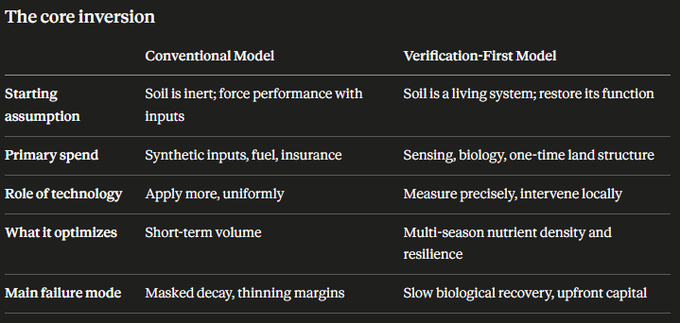
The first model monetizes control of a sterile environment. The second replaces chemical force with biological verification, and is honest that the switch has a cost and a timeline.
Read the soil, don't just dose it
Conventional fertilizing is a blanket guess: nitrogen and phosphorus spread uniformly across variable land on broad projections. Much of it leaches into water or evaporates before a plant uses it. That waste is one of the largest controllable losses in farming.
The alternative maps a field before planting, using in-ground sensors plus biological soil testing, and places inputs only where roots need them, favoring organic microbial inoculants over synthetic dumps. You feed the soil's own network instead of bypassing it.
What it doesn't do is control weather, atmospheric shifts, or commodity markets. Those risks are real. The honest version isolates and names them rather than burying them in a chemical cocktail.
Verification only counts if it's independent, and measured against the right standard
A farm covered in sensors sounds rigorous. But a machine scoring its own performance isn't verification. It's marketing with a dashboard. For the data to mean anything, what measures the crop has to be separated from what sells the inputs.
There's a subtler trap here, and it's the one most "regenerative" claims fall into. If you judge a field only against its own past, a farm can climb from total decay to merely poor soil and the system will happily report "improving," even "healthy," when it still doesn't compare to genuinely good soil in a wider sample. Improvement against your own worst state is real progress, but it is not the same as health. So you need two references, not one:
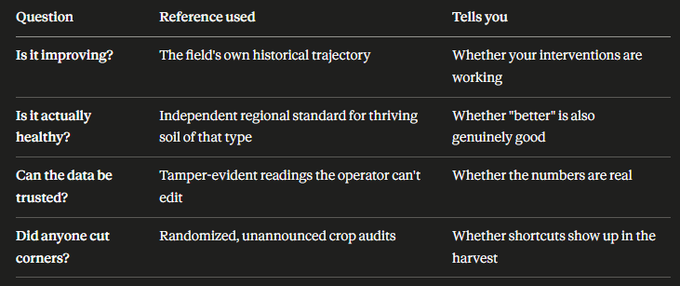
Progress is measured against yourself. Health is measured against an external benchmark you don't control. Without that second reference, the whole thing is just a more sophisticated way to grade your own homework.
Pests and weather are ecology problems, not sensing problems
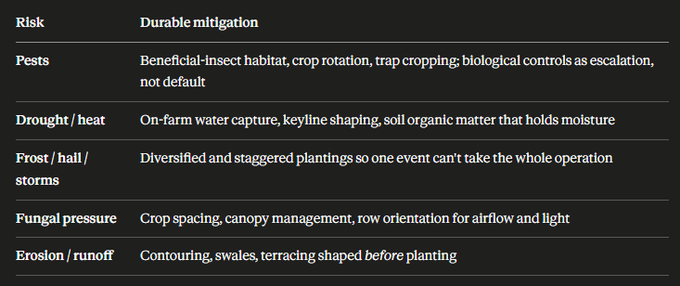
Detecting an outbreak early is useful, but detection isn't suppression, and a farm that drops chemical backstops is more exposed in a bad year until its ecosystem matures, not less. What lowers the risk is design, not gadgets:
Shape the land, and direct its flows
The cheapest, most durable intervention on any farm isn't an input. It's geometry and direction: how you shape the land and orient everything on it to work with the way light, water, and wind already move. Get it right once and it pays down maintenance for the life of the farm.
This is old knowledge. Long before soil science, traditions across the world developed sophisticated systems of directional and spatial design, Chinese feng shui most famously, alongside geomancy, sacred site-selection, and traditional agricultural siting. Stripped of their ceremonial language, these were empirical frameworks: centuries of accumulated observation about how orientation, flow, and form shape whether a place thrives or struggles. Modern landscape science measures the same effects with instruments now. The practice was right; we can finally say why. What follows is that knowledge stated as physics.
Direction governs light. The sun tracks east to west, so orientation decides how evenly a crop is lit. North–south rows let both sides catch direct sun through the day; poorly oriented rows shade themselves and waste light on bare soil. Slope aspect compounds it. A sun-facing slope warms earlier for an earlier start, with frost timing as the trade-off. This is the directional core feng shui always emphasized: orient to the sun and the prevailing forces, don't fight them. Here it's free yield left on the table by farms that plant to the property line instead of to the light.
Form governs water. This is where shaping earns the most. Laid out on contour, land slows, spreads, and sinks rainfall instead of letting it run off and carve erosion. Keyline geometry works water from valleys toward ridges so it distributes evenly. Swales, shallow contour ditches, bank water into the soil for dry weeks. Grade with intention and rain becomes a stored resource; ignore the form and the same rain becomes erosion and flood. The old principle that water must be guided, never fought, is literal hydrology.
Flow governs health. Spacing and orientation that let wind move through the canopy keep leaves dry, starving the fungal pressure and pests that thrive in stagnant, cramped layouts. Field shape and edges, paired with the right border plantings, decide whether margins host predator insects that hunt pests for free or simply invite trouble. Windbreaks placed by geometry cut evaporation, reduce stress, and steer cold air away from frost pockets, since cold air flows downhill and pools wherever the form lets it. Feng shui called this the management of flow through a space. A farm has real flows, air, water, light, movement, and directing them is the difference between a system that regulates itself and one you fight every season.
The foundation under all three is directional design: a farm is a system of flows you either shape on purpose or fight by accident. The traditions knew it by observation. The instruments now confirm it. Either way, the work is mostly one-time. Fighting it is a bill that arrives every season.
Let the crops defend each other
The same logic applies to what you plant, not just where. Crops chosen as complementary guilds protect and feed one another, replacing inputs with biology:
Legumes (beans, clover) pull nitrogen from the air into the soil, fertilizing the heavy feeders planted with them.
Trap crops lure pests away from the main crop, concentrating them where they're easy to handle.
Structural guilds like the classic corn-beans-squash stack three functions in one footprint: support, fertility, and ground cover.
Flowering borders host the predator insects that hunt pests for free.
Layer staggered maturity windows on top, and the field is never all vulnerable at once: pest pressure never hits a single synchronized peak, and harvest and risk spread across the season instead of arriving as one spike. Diversity isn't decoration. It's a defense system that costs nothing to run once it's designed.
Most of this is low-tech. It's the cheapest, most durable part of the system, and the part gadget-forward pitches tend to under-sell.
The economics, with the inconvenient part included
These pitches usually cheat by showing the savings and hiding the capital cost. Both belong on the page. Figures are illustrative, for a 1,000-acre operation, at a mid-range capital tier. They show direction, not a quote.
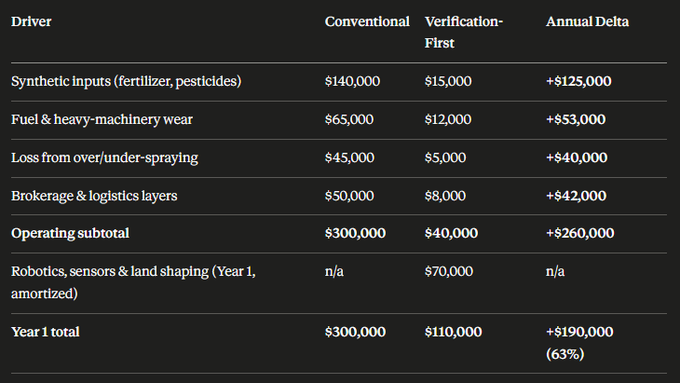
The recurring savings are large and immediate. The capital cost is front-loaded, but it declines as the fleet amortizes and sensing tapers off once biology is doing the work. So the gap widens every year:
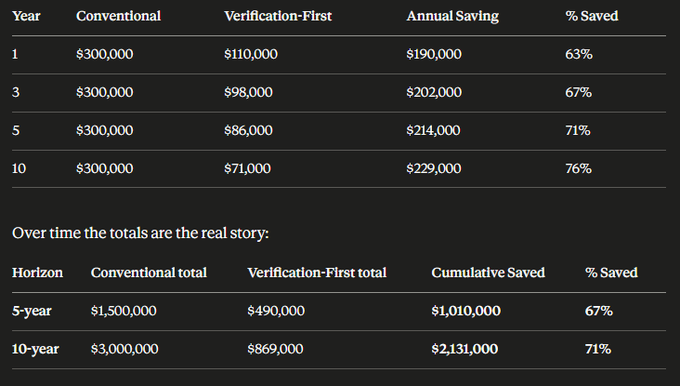
The real trade isn't free farming. It's swapping a permanent chemical tax for a capital cost that amortizes down, and once it does, you're saving roughly three-quarters of what the old model burned every year, indefinitely.
The climb: three phases, not a switch
Soil doesn't recover on a software schedule, and the returns don't arrive all at once. They build in stages, each one unlocking the next. The shape below is illustrative of the pattern, not a guaranteed yield figure:
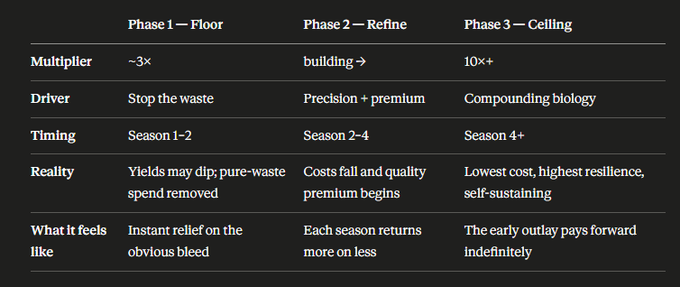
The first phase is the guaranteed win. Cutting spend that was pure waste pays off immediately, even before the soil recovers. The second compounds it, as precision tightens and verified quality starts earning a premium on the same acreage. The third is where it becomes self-sustaining: inputs hit a biological floor, resilience and yield rise together, and the early investment pays forward indefinitely.
That middle phase is also where most transitions fail financially, with lower yield, real costs, and biology not yet mature. It's where transition-support programs and patient capital matter most, and where subsidies cut both ways. Exiting the conventional system can forfeit insurance and payments built around it, while conservation programs can offset the hardest years. Those rules shift yearly and by region, so treat them as a live variable in the plan, not an afterthought.
One honest claim, not a utopia
The promise isn't climate-controlled perfection or zero-input farming. It's narrower and more defensible: most of what conventional agriculture spends money on is masking decay rather than building value. Close that gap, with verification nobody can game, health measured against a real external standard, resilience built into the land, and the capital and policy costs named out loud, and a large share of that spend simply stops being necessary.
The pattern underneath this
Here's the part worth sitting with: nothing above is really about farming.
Strip the soil and the rovers away and the structure is general. A system carries a heavy recurring cost that exists only to mask an underlying dysfunction. The fix follows the same three-phase climb every time. First you stop the obvious waste (the floor), then you refine and compound, then the foundation becomes self-sustaining and the early investment pays forward indefinitely (the ceiling). Verify each step against an honest external standard, let automation handle execution once the foundation is real, and the cost that felt permanent turns out to be optional.
That pattern applies to a person as readily as a farm. Think of the recurring drain of decisions, admin, and friction that masks a lack of underlying clarity. Restore the clarity, verify it honestly, automate the execution, and the same staircase appears: a floor that frees you immediately, a refining middle, and a ceiling where freed capacity compounds.
That's the premise we're building Raya.ai on. It's the same logic, pointed at your own work instead of a field. If the soil version made sense, the personal version is worth thirty seconds of curiosity. Raya AI
Nature was never the problem. Unpriced decay was, along with the temptation to claim the finish line before earning it.
Production that finally tells the truth, including the truth about its own costs.